Wednesday, August 12, 2009

Photo: St. Petersburg Times / ZUMA Press

Do you believe in canine guardian angels and the kindness of strangers? You just might after reading this story.

Early one morning, Yolanda Segovia's neighbor, Stacey Savige, knocked on her door and asked her to temporarily take in a stray dog she had found. The scruffy terrier mix had no collar or microchip. Segovia eyed the pooch -- burrs sticking to his belly and mud caking his fur -- and reluctantly agreed to foster him for the day.

An erstwhile hairdresser, Segovia hasn't worked since 2006. At 47, she is a survivor of breast cancer and cervical cancer. A divorced single mother of two, Segovia shares her Port Tampa, Florida home with her 10 year-old son Azaiah and 21 year-old son Christian. Her elder son has Down Syndrome; he cannot speak or bathe himself, and he has had heart surgery and a kidney transplant, reports the St. Petersburg Times.

Azaiah immediately took to the dog, whom he named RaeLee (pronounced "Riley"). Segovia and her sons bought the dog a collar, leash, ball and brown bed from the dollar store, and all that day, Azaiah played with the dog, laughing gleefully whenever RaeLee licked his face. "Don't fall in love with

Lost and Found Dog Saves Life of Boy with Down Syndrome - Paw Nation

Lost and Found Dog Saves Life of Boy with Down Syndrome - Paw Nation

Shared via AddThis

Sunday, July 19, 2009

Wings of an Angel Balto

My first Balto recut! I'm thinking about making other ones for other movies too. Taking the clips from the Universal movie Balto I came up with a little story. The story is this: Balto and Jenna ar...
My first Balto recut! I'm thinking about making other ones for other movies too. Taking the clips from the Universal movie Balto I came up with a little story. The story is this:
Balto and Jenna are in love, of course, but Steele wants Jenna. So the two fight and Balto comes out as the winner. Kinda like the movie but its just about the mushy love stuff.;)

The song is from Pirates of the Caribbean At World's End. Its one of the last scenes, which is my favorite out of the movie. The song is beautiful, Hans Zimmer is a genious! xD He did make the music for many of my favorite movies such as POTC, Balto and Spirit: Stallion of the Cimarron.

Copyrights:
Clips: Balto (c) Universal
Music: One Day (c) Disney + Hans Zimmer
Story: (c) CarribbeanLady

Wednesday, July 15, 2009

ChihuahuaSurvivesBrainFork

Chihuahua Survives 3 Days With BBQ Fork in Brain

Categories: Dogs, Pets in the News

Photo: SWNS.com

Here's one dog you probably won't find begging grill-side any time soon.

Smokey, a 12-week-old chihuahua puppy, ended up with a large barbecue fork in his brain after the utensil snapped in half on the grill, flew through the air, and impaled the poor puppy's head, reports the Telegraph. The terrified pup then ran off into the woods, where he hid for two days.

When his owner Hughie Wagers finally found him, Smokey was taken straight to the Cumberland Valley Animal Hospital, in London, Kentucky, where Michelle Duncum was on duty. Duncum said, "[W]hen he brought him in we couldn't believe our eyes."

X-rays showed that the fork was actually in the dog's brain, so the vet, Dr. Keaton Smith, only gave Smokey a 50/50 chance of surviving its removal. The operation itself only took about 30 seconds -- they just shaved Smokey's head and pulled the fork out. Thankfully the pint-sized pup is recovering wonderfully.

"His nerve endings around the eye still seem to be a little slow but I think that will heal over time," said Smith. "He really is a little miracle."

Warning: Graphic photo after the jump.

Photo: SWNS.com

Friday, May 22, 2009

LoboF836 Killed by Poachers_SaveAmerica'sWolves


Save America's Wolves

Dumped on the Roadside

http://action.defenders.org/site/R?i=

F836 one of just 52 lobos left in the wild was killed by a poacher shortly after being released to the wild. Federal officials said that prior to her death she “was on her way to being a successful animal…”

Yes! I want to help support on-the-ground wolf-saving work and emergency action to save the remaining lobos and other endangered wildlife with my tax-deductible donation of…

http://action.defenders.org/site/R?i=$25.00
http://action.defenders.org/site/R?i=$50.00
http://action.defenders.org/site/R?i=$100.00
http://action.defenders.org/site/R?i=My Donation for Lobos

http://action.defenders.org/site/R?i=

Donate now to help save the lives of lobos and other endangered animals.

Please help us raise $40,000 by Friday, May 22nd to support these vital efforts.

Dear Sharon,

She was one of the rarest in the world: a southwest wolf (also known as a lobo). Scientists gave her the designation F836 to keep track of her.

Raised in South Salem, New York’s Wolf Conservation Center, she was released with excitement into her native habitat in Arizona late last year.

But just two months later, a poacher killed her then dumped her like garbage along a road near Pinetop, Arizona. Sadly, her few remaining brethren could face a similar fate if we don’t act right now.

Please consider making a tax-deductible donation of $25.00, $50.00, $100.00 or whatever you can afford to help catch lawless wolf killers like the ones who senselessly killed wolf F836, fund our vital action in the courts to end mismanagement of the lobo recovery program and support our effective on-the-ground education, organizing and conservation efforts to save lobos like F836 and other endangered animals.

Lobos like F836 are the most endangered wolves in the world. Only 52 lobos -- and only two breeding pairs of these Southwest wolves -- now exist in the wild.

Your compassionate contribution today will help pay for rewards to bring the killer of wolf F836 to justice and catch other criminals who kill endangered wolves. According to the Fish and Wildlife Service, illegal shooting was the leading cause of documented loss of lobos in 2008.

With your help, we can bring the lawless wolf killers to justice, save our lobos and put them back on the road to recovery.

Your donation will also provide vital support for on-the-ground conservation work to save these magnificent animals, paying for fencing, range riders, fladry and other non-lethal tools we can use to keep lobos and livestock away from each other… and out of harm’s way!

Your contribution is also vital to our court battle to correct the terrible mismanagement that has undermined lobo recovery efforts. In 2007, 19 wolves were removed from the wild under flawed management policies now in place -- more than one-third of the lobos then in the wild.

We know there is a better way to manage wolves in the southwest. With the support of caring people like you, we recently scored an important initial legal victory in our case to return wolf management responsibilities to the U.S. Fish and Wildlife Service and to end the controversial “three-strikes” rule that has led to the unwarranted killing and removal of lobos from their natural habitat in the wild.

But we need your help save our lobos from extinction. Please give whatever you can afford today to fund these vital efforts and our ongoing programs to save the lives of endangered species.

There are only 52 lobos left in the wild, and the fight to save these magnificent wolves from extinction will be a tough one. But, with your help and rapid action, we can prevail. We owe it to wolves like F836 and other lobos.

For the Wild Ones,

Rodger SchlickeisenRodger Schlickeisen, President Signature
Rodger Schlickeisen
President
Defenders of Wildlife

P.S. There are only 52 Lobos left in the wild. Please make your life-saving gift today! You can make a secure tax-deductible donation online now or call 1-800-385-9712 to contribute over the phone.

Defenders Home Privacy Policy Contact Us Donate Now

This message was sent to shewolfeagle@aol.com.

Please do not respond to this message.
Click here to update your information or unsubscribe.

Defenders of Wildlife is a national, nonprofit membership organization dedicated to the protection of all native wild animals and plants in their natural communities.

Defenders of Wildlife can be contacted at:
1130 17th Street, NW
Washington, DC 20036


Friday, March 20, 2009

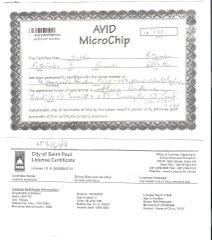
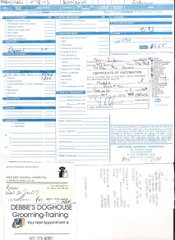
MaddysRabiesVacMar2012


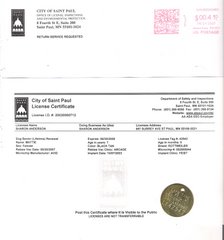
Maddys Licence2010 001 -----------------
Forwarded Message:
Subj:City of St. Paul, MN - Dog License RenewalRabies Tag167 to 2012
Date:3/20/2009 1:33:03 P.M. Central Daylight Time
From:Sharon4Anderson
To:karen.olson@ci.stpaul.mn.us, bob.kessler@ci.stpaul.mn.us, kathy.lantry@ci.stpaul.mn.us, chris.coleman@ci.stpaul.mn.us, john.harrington@ci.stpaul.mn.us, bob.fletcher@co.ramsey.mn.us, tim.butler@ci.stpaul.mn.us
CC:Shewolfeagle, Sharon4Anderson


Click here: City of St. Paul, MN - Official Website - Expiration & Renewal
FAX TRANSMITTAL/AFFIDAVIT OF SERVICE BY SHARON SCARRELLAANDERSON

Fri.20Mar09 To: Karen Olson Animal Control-Licenses City of St.Paul et al
651-266-9090 Fax: 651-266-9124
Pursuant to Mon16Mar09 Sharon Anderson's Rottweiller Lifetime License
Tag#42542 Maddy Black/Tan Microchip#053555044(Feist) Implant Date 10/07/03 AVID

AVID Animal Microchip - Google Search , had cause to take Maddy to the arcade animal hospital st paul mn - Google Search

Arcade Animal Hospital 1144 Arcade Street St. Paul, MN 55106 P: 651-772-3459 F: 651-772-1434. SINCE 1974. J. Patrick Ryan, D.V.M. . and by the Grace of God..Welcome to Yellow Cab Co.
Welcome to Yellow Cab Co, serving Saint Paul, MN and surrounding areas. ... Yellow Cab Co. 1463 Marshall Avenue Saint Paul, MN 55104 Phone: (651) ...
www.stpaulyellowtaxi.com/ - 14k -
Cached - Similar pages - transported my Maddy,
Maddy 9 yrs Rottweiller apparantly has OA, OstroAthritis, treated with Metacam
$83.00 3yr Rabies Vac.Ex.2012 tag no.167,$46.00,Metacam $83.00 Invoice No 4642
To be Faxed/Filed with your Office today at 1:30pm
Thank You, returned receipt y e-mail confirmation appreciated

SharonsWritProA06_1150_30Jun06_26
YouTube - Sharon4Anderson's Channel The stress Sun.15Mar09 of Fire Trucks with Bogus Gas leak at 693 Surrey St.Paul,MN 55106 has added extreme STRESS,Health related to the Neighbors and My Dog and Me.................NOTICE TO ESTOPP HARRASSING SHARON ANDERSON IMMEDIATELY, RETURN OF CAR,TRAILER,PERSONAL PROPERTYS
AllMN Sharon Anderson's Blog Channel Code-Corruption Thank You in Advance
/s/ Sharon4Anderson@aol.com ECF_P165913_sa1299 Sharon Scarrella Anderson's Page - We The People USA
political ?(Sharon4Anderson?)
Alliance for a Better Minnesota Sharon Anderson's Blog Click here: Sharon4Council file4[1]Shar_thune_22.pdf - Google Docs
Disclaimer on Site'sThe Electronic Communications Privacy Act MY FindLaw (ECPA) sets out the provisions for access, use, disclosure, interception and privacy protections of electronic communications. Sharon4Anderson Scribd pdf files. The law was enacted in 1986 and covers various forms of wire and electronic communications. According to the U.S. Code, electronic communications "means any transfer of signs, signals, writing, images, sounds, data, or intelligence of any nature transmitted in whole or in part by a wire, radio, electromagnetic, photo electronic or photo optical system that affects interstate or foreign commerce." ECPA prohibits unlawful access and certain disclosures of communication contents. Additionally, the law prevents government entities from requiring disclosure of electronic communications from a provider without proper procedure. The Legal Institute provides Title 18 of the U.S. Code, which encompasses ECPA. Blogger: Dashboard

NOTICE: This communication is not encrypted. This e-mail (including any attachments) is covered by the Electronic Communications Privacy Act, 18 U.S.C. §§ 2510-2521, and Electronic Communications Privacy Act The CAN-SPAM Act: Requirements for Commercial Emailers


Sunday, February 22, 2009

Blackie Born 1992 Died Fri.1:20am17Jan09

MVC-001S RockYou.com - Photo sharing, MySpace slideshows,

Can't seem to edit, Blakie came to 697 Surrey Ave 1992 as a Stray, died 17Jan09, video her obit when Obama sworn in 20Jan09

I have so many sites and e-mails, prefer Fans only no e-mail, unless Family with pic's

Have to transcribe: This is the best I can do for now, Pic's from floppy disks so have to download

Wednesday, February 18, 2009

1st Movie MaddySharonMe

Maddys eyes are better, gave her Bildberry, tea bags on the eyes.

Tuesday, February 17, 2009

Rottweiller Entropian Eye Disease

Google Image Result for http://www.rottstop.com/r/kodisclub/Nina/Nina_0811.jpgSure hope
Maddy does not have this, it came on in a day??????

Nina

Nina - Female Rottie from NYCACC. Kodi's Club saved this Rottie Girl. She was seized and her owner was arrested for various felonies. We are working with Kodi's Club with Nina's rehabilitation here with us. If you are interested in fostering Nina or providing Nina a future forever home. Please contact us for our Rottweiler Adoption Questionnaire.

Oh this is a Happy Kissy Face Kinda Rottie-Girl! She can be a velcro dog. She loves people and loves to play with the other dogs here. Yes she does have her full Natural tail as the German Breed Standard for the Rottweiler (Which is a German Dog) A Very loving dog. Nina overall has a great temperament and is very play and food motivated. more Snow Play Pics here

Nina had her bi-lateral entropian eye surgery and now she can actually open her eyes completely. She is healing and doing well.

At Shelter

C.A.R.E.S. Canine Vaccine Advocacy


my maddy does not have this

Thursday, February 12, 2009

Brunotte v. City StPaul,DSI_A08-0173

This opinion will be unpublished and

may not be cited except as provided by

Minn. Stat. § 480A.08, subd. 3 (2008).

STATE OF MINNESOTA

IN COURT OF APPEALS

A08-0173

Malisa M. Brunotte, Relator, vs. City of St. Paul Office Safety & Inspections, Respondent.

Filed February 10, 2009

Affirmed

Schellhas, Judge

City of St. Paul Office of Safety & Inspections

Amy B. Draeger, 2935 Buchanan Street Northeast, Minneapolis, MN 55418 (for relator)

John J. Choi, St. Paul City Attorney, Virginia D. Palmer, Assistant City Attorney, 400 City Hall and Courthouse, 15 West Kellogg Boulevard, St. Paul, MN 55102 (for respondent)

Considered and decided by Minge, Presiding Judge; Schellhas, Judge; and Connolly, Judge.

U N P U B L I S H E D O P I N I O N

SCHELLHAS, Judge

Relator challenges the designation of her dogs as "dangerous animals" under the St. Paul Legislative Code, arguing that (1) she was deprived of her due process rights, (2) the hearing officer‟s decision was unsupported by substantial evidence and was 2

arbitrary and capricious, and (3) the definition of "dangerous animal" in the St. Paul Legislative Code is preempted by state law. We affirm.

FACTS

In October 2007 a St. Paul police officer responded to a report that a woman and a 14-year-old girl were chased and bitten by two dogs. One victim was bitten on her right knee and upper left hamstring, and the other was bitten on her upper left thigh. The officer described both bites as two or three inches in length and looking like "scratch marks." A family member of the victims, B.H., who tried to scare away the dogs, also was bitten by one of the dogs, resulting in a "small scrape" on his knee about one-and-one-half inches long. The officer filed an incident report in which he reported that each of the three victims suffered an "apparent minor injury" as a result of the dog bites. The dogs were subsequently identified as two boxers, named Sadee and Brutis, owned by relator Malisa May Brunotte.

Relator‟s dogs were seized on October 10, 2007. Respondent City of St. Paul, Office of Safety & Inspections, addressed two letters to relator, also dated October 10, 2007, notifying her that her dogs were declared "dangerous animals" under the St. Paul Legislative Code (SPLC). St. Paul, Minn., Legislative Code § 200.12(a)(1), (2) (2007). The letters informed her that she had until October 25, 2007 to request a Dangerous Animal Seizure Hearing. Relator requested a hearing, which was held on October 22, 2007.

At the hearing, B.H. testified that he was in the basement of his nephew‟s house when one of the victims ran inside and told him that she and her companion had been 3

bitten by dogs. He came outside, saw one dog, and tried unsuccessfully to shoo it away. In an attempt to prevent it from biting, he grabbed the dog by the head when a second dog approached. One of the dogs bit B.H. on his left knee but he did not know which dog bit him. B.H. admitted that he had been drinking alcohol at the time of the incident. The female victims did not testify at the hearing.

Relator testified that on the date in question her dogs got loose when she took them outside. While looking for her dogs, she encountered one of the female victims who reported that the dogs had bitten her. Relator testified that the female victims had marks that looked like scratches, but that B.H.‟s knee looked like a "big chunk was taken out of [it], like he had fallen." Relator testified that she then saw one of her dogs being chased down a hill by two men, one carrying a chair and the other carrying a dowel. Relator also testified that she took good care of her dogs and that neither of them acted aggressively before the incident. Relator offered three letters as evidence of her dogs‟ temperament and history, but the hearing officer rejected two of the letters because they did not contain addresses for the authors and one of them contained the author‟s typed name but no signature. The hearing officer accepted a third letter by an author who also testified.

In November 2007 the hearing officer issued Dangerous Animal Notification/Agreements for each dog, informing relator that the dogs were determined to be dangerous animals and that relator had to meet several conditions to prevent her dogs from being destroyed. Thereafter, relator (1) procured muzzles and a secure outdoor-cabling system, (2) posted her residence with two dangerous-animal warning signs, 4

(3) had microchips implanted in her dogs, (4) affixed dangerous-animal tags to her dogs‟ collars, (5) provided a certificate of liability insurance to the city, (6) purchased two St. Paul lifetime dog licenses, (7) registered her dogs with Ramsey County, and (8) paid two annual registration fees. As a result of meeting these conditions, relator‟s dogs were returned to her in early December 2007. Relator initiated certiorari appeal challenging the determination that her dogs are dangerous animals.

D E C I S I O N

On certiorari review, the court is limited to considering whether (1) the agency had jurisdiction, (2) the proceedings were fair and regular, and (3) the agency‟s decision was unreasonable, oppressive, arbitrary, fraudulent, without evidentiary support, or based on an incorrect theory of law. Dietz v. Dodge County, 487 N.W.2d 237, 239 (Minn. 1992). Evidence is reviewed "only to determine whether it supports the findings of fact or the conclusions of law, and whether the municipality‟s decision was arbitrary or capricious." In re Dakota Telecomm. Group, 590 N.W.2d 644, 646 (Minn. App. 1999).

I.

Relator claims that respondent deprived her of her due-process rights when it declared her dogs "dangerous animals" without (1) providing timely notice of evidence-authentication requirements that would be followed at the dangerous-animal hearing, and (2) conforming to the procedural requirement in the dangerous-animal ordinance that the hearing officer shall consider "all evidence pertaining to the temperament of the animal." Procedural due-process issues are reviewed de novo. Plocher v. Comm’r of Pub. Safety, 681 N.W.2d 698, 702 (Minn. App. 2004). 5

The due-process clause requires that deprivations of life, liberty, or property by adjudication be preceded by adequate notice and meaningful opportunity to be heard. Mathews v. Eldridge, 424 U.S. 319, 333, 96 S. Ct. 893, 902 (1976); Goldberg v. Kelly, 397 U.S. 254, 267, 90 S. Ct. 1011, 1020 (1970). While due process requires "the government to afford notice and a meaningful opportunity to be heard" before property is seized, United States v. James Daniel Good Real Property, 510 U.S. 43, 62, 114 S. Ct. 492, 505 (1993), the concept of due process is "flexible and calls for such procedural protections as the particular situation demands," Am. Dog Owners Ass’n v. City of Minneapolis, 453 N.W.2d 69, 71 (Minn. App. 1990) (quotation omitted).

To determine whether an individual‟s right to procedural due-process has been violated, a reviewing court first determines whether a protected liberty or property interest is implicated and then determines what process is due by applying a balancing test. Sweet v. Comm’r of Human Servs, 702 N.W.2d 314, 320 (Minn. App. 2005) (citing Mathews, 424 U.S. at 332, 335, 96 S. Ct. at 901, 903), review denied (Minn. Nov. 15, 2005). Dogs are personal property under Minnesota law. Corn v. Sheppard, 179 Minn. 490, 492, 229 N.W.2d 869, 870 (1930). We therefore conclude that a protected property interest is implicated and proceed to apply the Mathews balancing test. The Mathews test requires this court to consider: (1) "the private interest that will be affected by the official action"; (2) "the risk of an erroneous deprivation of such interest, through the procedures used, and the probable value, if any, of additional or substitute procedural safeguards"; and (3) "the government‟s interest, including the function involved and the 6

fiscal and administrative burdens that the additional or substantive procedural requirements would entail." Id.

Private Interest Affected

The first part of the Mathews test considers the private interest that will be affected by the action. Mathews, 424 U.S. at 335, 96 S. Ct. at 903. Relator asserts that her private interest in her dogs is significant because she provides care for her dogs and her children are attached to them. Relator argues that the private interest at issue is her "freedom and ability to provide a quality of life for her children, herself, and her dogs." But in American Dog Owners, we evaluated a procedural due-process challenge to an ordinance similar to that at issue in this case and concluded that "[p]rivate parties have little interest in harboring animals that may be dangerous." 453 N.W.2d at 71. Despite relator‟s contention that her dogs are not dangerous and that the city‟s dangerous-dog declarations have imposed significant financial and emotional costs upon her, we conclude, as in American Dog Owners, that relator has little interest in harboring dogs that may be dangerous. Thus, the first Mathews factor weighs against relator.

Risk of Erroneous Deprivation of Property Interest

The second Mathews factor is the risk, if any, of an erroneous deprivation of relator‟s property and the possible value of additional safeguards. Mathews, 424 U.S. at 335, 96 S. Ct. at 903. Relator argues that she was erroneously deprived of her property rights because she had no notification of the "evidence authentication requirements" that applied to the hearing, and that as a result, two letters she submitted as evidence of her dogs‟ temperament were rejected by the hearing officer. The primary function of notice 7

is to inform a party of how government action affects the party‟s interests. Schulte v. Transp. Unlimited, Inc., 354 N.W.2d 830, 834 (Minn. 1984). Notice is adequate if it communicates the adverse consequences of governmental action. Id. Notice is inadequate if it fails to communicate the interest at stake or is actively misleading. Plocher, 681 N.W.2d at 705.

Here, the notices sent to relator informed her that her dogs shall be seized, that she had the right to request a hearing, and that "[f]ailure to respond will result in an order for the destruction of the animal." Although the notices contain no references to evidentiary rules, they satisfy the requirement that they communicate the interest at stake and the adverse consequences of governmental action. We conclude that the notices were sufficient to satisfy relator‟s procedural due-process rights.

Relator also argues that she was erroneously deprived of her property rights because the hearing officer failed to consider "all evidence" pertaining to the dogs‟ temperament as required by SPLC section 200.12(c)(1)(d). St. Paul, Minn., Legislative Code § 200.12(c)(1)(d) (2007). Section 2.15 of the SPLC states that the rules of statutory construction established in the Minnesota Statutes shall generally apply to the interpretation of the code. St. Paul, Minn., Legislative Code § 2.15 (2008). Legislative intent controls the interpretation of statutes, Minn. Stat. § 645.16 (2008), and courts may presume that the legislature did not intend an absurd or unreasonable result, Minn. Stat. § 645.17 (1) (2008). Relator‟s interpretation of SPLC section 200.12(c)(1)(d), that it requires a hearing officer to consider all evidence, including unreliable or irrelevant evidence, would lead to an absurd result. We therefore reject relator‟s interpretation of 8

SPLC section 200.12(c)(1)(d), and conclude that the second Mathews factor weights against her.

Relator‟s argument that she was erroneously deprived of her rights to her dogs because the hearing officer did not consider "all evidence pertaining to the temperament of the animal" as required by SPLC section 200.12(c)(1)(d) is also colorable as a separate and distinct argument from her due-process challenge. A city‟s failure to follow its own procedural requirements may render its actions void or voidable. See Hamline-Midway Neighborhood Stability Coal. v. City of St. Paul, 547 N.W.2d 396, 399 (Minn. App. 1996) (holding that a city‟s failure to follow its own ordinance in issuing a license without a public hearing rendered its actions voidable), review denied (Minn. Sept. 20, 1996). But, because we conclude that SPLC section 200.12(c)(1)(d), does not require a hearing officer to consider all evidence, regardless of its reliability, we determine that the hearing officer did not violate the city‟s procedural requirements in rejecting the two letters.

Government Interest

The third Mathews factor considers the government‟s interest, including the fiscal and administrative burdens that the additional procedural requirements would involve. Mathews, 424 U.S. at 335, 96 S. Ct. at 903. As this court stated in American Dog Owners, a city "has a high interest in taking appropriate measures for animal control." 453 N.W.2d at 72. Relator provides no authority for the proposition that respondent has a legal duty to provide notice of its rules of evidence nor does it appear that respondent has adopted formal rules of evidence. We conclude that the third Mathews factor weighs 9

against relator and her procedural due process challenge fails. See Am. Dog Ass’n, 453 N.W.2d at 71-72 (concluding that a procedural due-process challenge fails where none of the Mathews factors weighed in favor of the party making the challenge).

II.

Relator argues that respondent‟s declaration that her dogs were "dangerous animals" was not supported by substantial evidence. "Substantial evidence" means (1) "such relevant evidence as a reasonable mind might accept as adequate to support a conclusion"; (2) "more than a scintilla of evidence"; (3) "more than „some evidence‟"; (4) "more than any evidence"; and (5) "evidence considered in its entirety." Reserve Mining Co. v. Herbst, 256 N.W.2d 808, 825 (Minn. 1977).

Relator argues that the hearing officer‟s conclusion was unsupported by substantial evidence because B.H. admitted that he was drinking alcohol at the time of the incident, apparently challenging the hearing officer‟s reliance on B.H.‟s testimony as credible. The hearing officer did not mention B.H.‟s alcohol use in her decision. Determinations of witness credibility are "the sole province of the finder of fact." Citizens Nat’l Bank of Madelia v. Mankato Implement, Inc., 441 N.W.2d 483, 485 (Minn. 1989). This court will not disturb the hearing officer‟s credibility determination about B.H.‟s testimony. Relator also argues that the hearing officer‟s conclusion was unsupported by substantial evidence because no photographic evidence exists to substantiate any of the victims‟ injuries. But the record contains substantial evidence about the victims‟ injuries in the form of B.H.‟s testimony and the police report. Even relator testified that she saw two marks behind the right knee of one of the female victims 10

and that B.H.‟s knee looked "like a big chunk was taken out of [it]." The record contains substantial evidence supporting the hearing officer‟s findings in this case, and we therefore affirm these findings.1 Relator also argues that because a police report describes the victims‟ injuries as "apparent minor injury," the hearing officer‟s conclusion was unsupported by substantial evidence. Relator suggests that "substantial evidence" requires a police report of a dog tearing flesh or limb from a victim or biting deeply into a victim‟s skin, or credible witness testimony that a dog shook and would not release a victim‟s limb, or medical or photographic evidence of injuries. But the plain text of the SPLC does not indicate that serious injury, or indeed any injury, must result from the attack in order to support a "dangerous animal" designation. Section 200.12(a)(2) of the SPLC defines "dangerous animal" as one that "[w]ithout provocation engaged in any attack on any person under circumstances which would indicate danger to personal safety." We conclude that relator‟s argument about the requirement of substantial evidence lacks merit.

1 Moreover, relator‟s arguments are difficult to reconcile with the fact that, at the hearing, relator did not dispute that her dogs bit the victims.

Relator further argues that respondent‟s declaration that her dogs were "dangerous animals" was not supported by substantial evidence because the attacks were provoked. Indeed, a "dangerous animal" is one that engaged in any attack without provocation. Id. Relator cites B.H.‟s testimony that that he "grabbed" and "had the head" of one of the dogs and guessed that the other dog "came in the defense of his partner." Respondent argues that B.H. did not provoke the attack on him because he acted only with intent to 11

prevent the dogs from attacking anyone else besides the female victims. Relator‟s argument does not address the evidence in the record that the dogs‟ attacks on the two female victims were unprovoked. See Hannan v. City of Minneapolis, 623 N.W.2d 281, 286 (Minn. App. 2001) (concluding that evidence in the record strongly suggesting that "several, if not all, of the dog‟s attacks were unprovoked" justified the hearing officer‟s affirmation of an order to destroy a dangerous dog).

Relator also asserts that when two men with a dowel and a chair chase dogs from the scene of a dog attack, as relator testified that she witnessed, it is reasonable to conclude that the dogs were provoked at the scene of the attack. This assertion is illogical, because reasonable persons might take similar actions in response to an unprovoked dog attack. Relator cites Bailey by Bailey v. Morris, 323 N.W.2d 785, 787 (Minn. 1982), in which the jury found provocation where a minor, despite being warned, approached a growling dog with pups that other children would not approach. But the Bailey court considered the conduct of a dog-bite victim prior to the attack, and relator‟s attempt to apply Bailey to impute provocation from the actions of other people after the attack is unconvincing. We therefore reject relator‟s argument that the hearing officer‟s decision was not supported by substantial evidence.

III.

Relator argues that respondent‟s declaration that her dogs were "dangerous animals" was arbitrary and capricious. A decision may be deemed arbitrary and capricious only if: (1) it relied on factors not intended by the ordinance; (2) it entirely failed to consider an important aspect of the issue; (3) it offered an explanation that 12

conflicts with the evidence; or (4) it is so implausible that it could not be explained as a difference in view or the result of the city‟s expertise. Minnegasco v. Minn. Pub. Utils. Comm’n, 529 N.W.2d 413, 418 (Minn. App. 1995), rev’d on other grounds, 549 N.W.2d 904 (Minn. 1996).

Relator first argues that the hearing officer‟s conclusion was arbitrary and capricious because the hearing officer failed to consider the less punitive "potentially dangerous" designation for her dogs. Under SPLC section 200.11, a "potentially dangerous animal" is one that has, "[w]hen unprovoked, bitten a human or a domestic animal" or "[w]hen unprovoked, chased or approached a person upon the streets, sidewalks, or any public or private property, other than the animal owner‟s property, in an apparent attitude of attack." St. Paul, Minn., Legislative Code § 200.11(a)(1),(2) (2007). In contrast, under SPLC section 200.12(a)(2), a "dangerous animal" is one that "without provocation engaged in any attack on any person under circumstances which would indicate danger to personal safety." "Dangerous animal" is defined more broadly than "potentially dangerous animal" because the conduct of a "dangerous animal" is not limited to biting and need not occur on property other than the animal owner‟s property. Here, the hearing examiner determined that relator‟s dogs are "dangerous animals" based on the evidence that they attacked B.H. and the female victims without provocation under circumstances that indicate danger to personal safety. Relator provides no legal support for her argument that simply because the evidence would also support a declaration that her dogs are "potentially dangerous animals," the hearing officer was required to apply the less punitive ordinance. 13

Relator also argues that the hearing officer‟s decision was arbitrary and capricious because the hearing officer did not describe the victims‟ injuries using medical terms or assessment tools used by professionals. The hearing officer referred to the locations of the injuries in the decision and described them as "bites" and a "gash." While relator describes a number of methods by which a hearing officer may describe injury, such as the Dunbar Bite Level scale or by the terms used in Minnesota criminal statutes to describe bodily injury, she provides no legal support for her argument that a hearing officer acts arbitrarily and capriciously in not using these methods or in not using formal or technical terms rather than plain language to describe injuries. Thus, relator‟s argument lacks merit.

Relator further argues that the hearing officer‟s decision was arbitrary and capricious in that it failed to discern which dog, or whether both dogs, inflicted the injuries in the incident. The hearing officer observed that the dogs were originally seized as "dangerous animals" under SPLC section 200.12(a)(1) and (2), but concluded only that the seizure was justified without referring to the provision under which the seizure was justified. Respondent concedes that because the record does not show which dog, or whether both dogs, inflicted the injuries, it is insufficient to support a conclusion that the dogs are "dangerous animals" under SPLC section 200.12(a)(1), which defines a "dangerous animal" as one that has "[w]ithout provocation caused bodily injury or disfigurement to any person on public or private property." But respondent argues that the record is sufficient to support the hearing officer‟s declaration that the dogs are "dangerous animals" under SPLC section 200.12(a)(2), because a "dangerous animal" is 14

one that "[w]ithout provocation engaged in any attack on any person under circumstances which would indicate danger to personal safety." The definition does not require personal injury. In this case, substantial evidence shows that both dogs participated in the attack of the victims, even if only one caused the physical injuries. Relator therefore fails to show that the hearing officer‟s decision was arbitrary and capricious.

IV.

Relator argues that the hearing officer should have applied the statutory definition of "dangerous dog": a dog that "without provocation, inflicted substantial bodily harm on a human being on public or private property." Minn. Stat. § 347.50, subd. 2(1) (2006) (emphasis added). Relator cites section 2.18 of the SPLC, which states that "unless clearly in conflict with definitions, context, or provisions of this Code, or for some other reason clearly inapplicable, definitions established for the State of Minnesota by statute or caselaw shall apply to the Saint Paul Legislative Code." St. Paul, Minn., Legislative Code § 2.18 (2008). Relator argues that under SPLC section 2.18, because section 200.12(a)(1) of the SPLC contains the term "bodily injury" rather than "substantial bodily harm" in its definition of a dangerous animal, section 200.12(a)(1) is preempted by Minn. Stat. section 347.50.

But respondent has conceded that the terms of SPLC section 200.12(a)(1) are not applicable in this case, and relator ignores that SPLC section 200.12(a)(2) does not require "bodily injury" but only an attack that "would indicate danger to personal safety." Moreover, the supreme court addressed the local regulation of dangerous animals in Hannan, stating that "the legislature has neither expressly nor impliedly indicated that the 15

subject matter is solely a matter of state concern. In fact, state law expressly provides for local regulation." 623 N.W.2d at 285; see also Minn. Stat. §§ 347.53, .51, subd. 8 (2008) ("Any statutory or home rule charter city, or any county, may regulate potentially dangerous and dangerous dogs" as long as the regulations are not breed specific.). Therefore, even if SPLC section 200.12(a)(1) applied in this case, respondent is not precluded from using its more restrictive definition of "dangerous animal."

Affirmed.

ChuChu Pals with Bella

ChuChu Pals with Bella

Bella Therapy Chihuahua

Bella Therapy Chihuahua
Bella & ChuChu2013_Pals

Maddy & Me

Maddy & Me
MaddyDied13Mar12_LoveForever

Sharon4Council 3

Rottweiller Maddy-Me

Rottweiller Maddy-Me
MicroChip,Licenses

Maddys Licenses

Maddys Licenses

MaddyLicense-42542

MaddyLicense-42542

Maddys Shots

Maddys Shots